AI-Powered Phishing: How Hackers Are Using Artificial Intelligence Against Connecticut Businesses
The Phishing Attack Your Security Training Was Not Built to Stop
For years, the standard advice for spotting phishing emails was practical and effective: look for poor grammar, generic greetings, suspicious sender addresses, and urgent requests for action. Security awareness training drilled employees on these signals. The approach worked reasonably well because most phishing was mass-produced, impersonal, and grammatically flawed.
That era is ending. Artificial intelligence has given cybercriminals capabilities that fundamentally change the threat landscape — and much of the security training your Connecticut employees received in the past two to three years is already outdated in ways that matter.
This article explains how AI is being weaponized against businesses like yours, what the new attacks look like, and what updated defenses actually work in 2026.
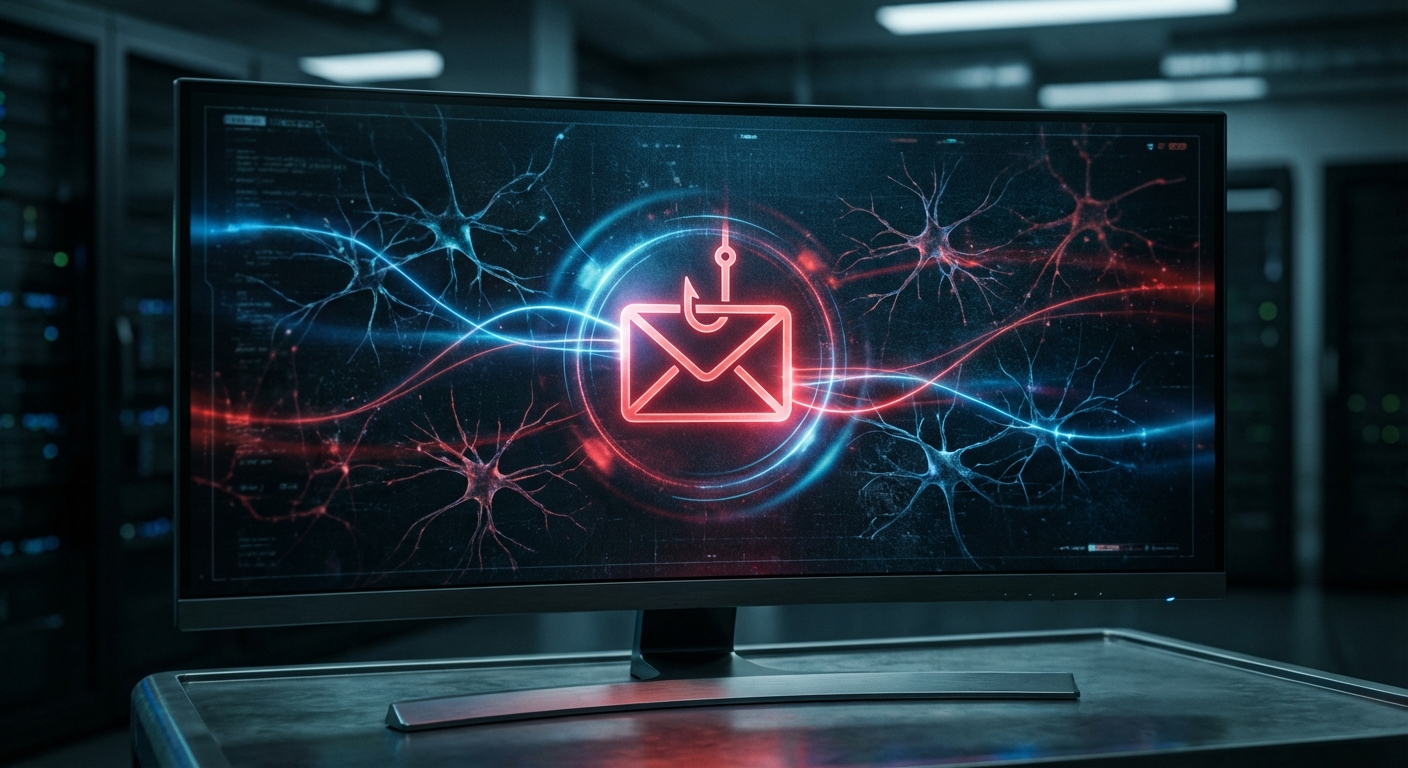
Sarthak's Take: I have reviewed phishing emails with Connecticut clients that were genuinely indistinguishable from legitimate correspondence — no spelling errors, correct company names, accurate job titles, references to real projects. The only tell was a domain that was one character off. When I ask business owners if their employees would catch that, the honest answer is: probably not. The threat has changed, and defenses need to change with it.
How AI Is Changing Phishing Attacks
The criminal use of AI in phishing operates across four distinct and increasingly dangerous capabilities:
1. AI-Generated Spear Phishing at Scale
Traditional spear phishing — personalized attacks targeting specific individuals — was time-consuming. Attackers had to research each target, craft a custom email, and send it manually. This limited spear phishing to high-value targets like C-suite executives at large companies.
Large language models have eliminated that constraint. Using publicly available data — LinkedIn profiles, company websites, press releases, social media, news articles — AI tools can now generate thousands of highly personalized phishing emails in hours. An AI system can scan your company website to learn your clients, services, and team structure, then craft a phishing email to your office manager that references your actual accountant, a real client name, and a plausible invoice scenario.
The result: spear phishing attacks increased by 47% in 2024 according to Barracuda Networks, with AI-generated content cited as a primary driver. Small businesses that were previously below the threshold of targeted attacks are now reachable at scale.
2. Voice Cloning for Business Email Compromise (BEC)
Business email compromise — where attackers impersonate executives or trusted vendors to authorize fraudulent wire transfers — is the costliest form of cybercrime by dollar value. The FBI's Internet Crime Complaint Center (IC3) reported $2.9 billion in BEC losses in 2023, and voice cloning is making these attacks dramatically more convincing.
With as little as three seconds of a person's voice (available from a YouTube video, a voicemail greeting, or a LinkedIn audio post), AI voice cloning tools can generate synthetic audio that is nearly indistinguishable from the original speaker. In 2024, a Connecticut area finance director received what appeared to be a voicemail from her CEO approving an emergency wire transfer. The voice was a convincing clone. The wire was for $340,000.
These attacks typically follow a pattern: an email arrives claiming the CEO needs an urgent wire transfer, followed by a phone call or voicemail "confirming" the request — with the CEO's cloned voice. Employees trained to verify wire transfers by calling back are circumvented when the call-back itself is the fraud.
3. Deepfake Video for Executive Impersonation
Real-time deepfake video — where a person's face and voice are replaced with someone else's in a live video call — has become accessible to sophisticated threat actors. In early 2024, a multinational company lost $25 million after an employee was deceived into transferring funds during a video call featuring deepfake versions of the company's CFO and other executives. The employee only discovered the fraud after the call.
For Connecticut small businesses, the more immediate risk is less dramatic: AI-generated video and images used to create fake "proof" of identity in onboarding scenarios, vendor verification processes, or client communications.
4. AI-Optimized Phishing Infrastructure
Beyond the social engineering content itself, AI is being used to optimize phishing campaigns operationally: identifying the best times to send emails to specific targets based on behavioral patterns, A/B testing subject lines for maximum open rates, generating convincing landing pages that mimic legitimate sites, and evading email security filters by analyzing and adapting content to avoid detection signals. The effect is a professionalization of phishing operations that makes them faster, more targeted, and more effective at scale.
Why Traditional Defenses Are Less Effective
The security controls that worked well against the previous generation of phishing attacks have been partially degraded by AI-enhanced threats:
- "Check for bad grammar" training: No longer reliable. AI-generated phishing is grammatically flawless, tonally appropriate, and contextually specific. This signal is largely gone.
- Email sender verification: Still important, but AI-assisted attackers use convincing lookalike domains (sentiumtech.co vs. sentiumtech.com), compromised legitimate email accounts, and sophisticated spoofing. DMARC enforcement helps but is not a complete defense.
- Verbal confirmation for wire transfers: Partially undermined by voice cloning. "Call the CEO to confirm" is still better than nothing, but voice alone is no longer sufficient verification for high-value transfers.
- Annual phishing simulations: If your simulation library has not been updated to reflect AI-generated content quality, you are training employees to spot attacks that no longer represent the current threat.
Updated Defenses That Work Against AI-Enhanced Phishing
The good news: effective defenses exist. They require updating your approach, not replacing it entirely.
Technical Controls
- Advanced email security with AI-based detection: Modern email security platforms (Microsoft Defender for Office 365 Plan 2, Proofpoint, Abnormal Security) now use behavioral AI to detect anomalous communication patterns — even when the content is grammatically perfect. They analyze sender behavior, communication history, and contextual signals rather than just content. Update your email security solution if you are still running rules-based filtering only.
- DMARC enforcement (p=reject): Still essential. DMARC in enforcement mode prevents attackers from sending email that appears to come directly from your domain. This stops the most straightforward spoofing attacks. Combined with AI-based detection, it significantly reduces attack surface.
- Multi-factor authentication on all accounts: Even when a phishing attack succeeds in capturing credentials, MFA prevents attackers from using those credentials to access accounts. This remains the highest-ROI single control against phishing-led account compromise.
- DNS filtering: Blocks connections to known phishing infrastructure and malicious domains — including AI-generated phishing landing pages that mimic legitimate sites.
- Browser isolation for high-risk users: For executives and finance staff, browser isolation technologies render web content in a remote environment, preventing local execution of malicious scripts from phishing landing pages.
Process Controls
- Out-of-band verification for wire transfers: Establish a policy that all wire transfers over a defined threshold (e.g., $5,000) require verification through a pre-established, out-of-band channel — a known phone number called by the requester's manager, not a number provided in the request itself. This process must be documented and consistently enforced, even under claimed urgency.
- Dual-approval for financial transactions: Require two people to approve and initiate any wire transfer. This is the most reliable process control against BEC — it eliminates single-point-of-failure scenarios entirely.
- Code words for emergency verification: For voice-call-based fraud scenarios, establish a shared verification code word between executives and finance staff. A caller who cannot provide the code word — regardless of how convincing the voice — does not get the wire transfer approved.
- Vendor verification protocols: Before updating payment details for any vendor, require in-person or verified-identity confirmation. AI-generated impersonation of vendors requesting updated ACH details is a frequent and costly attack vector.
Updated Training
- Retire the "check for grammar errors" heuristic: Update your security awareness training explicitly to tell employees this signal is no longer reliable. Replace it with process-based verification: if any communication involves money, credentials, or sensitive data access, verify through a separate channel regardless of how legitimate the communication looks.
- Run AI-quality simulations: Update your phishing simulation library to include AI-generated content — polished, personalized, contextually relevant messages. Employees need to practice identifying threats that match current attacker capabilities, not 2020-era templates.
- Educate on voice and video threats: Explicitly train employees that voice calls and video calls can be faked. This is new threat awareness that most Connecticut small business teams have not received. The goal is not paranoia — it is appropriate skepticism and verification discipline around financial transactions.
Connecticut Business Context
Several factors make Connecticut small businesses particularly relevant targets for AI-enhanced phishing:
- Professional services concentration: Hartford County has a high density of law firms, accounting practices, financial services firms, and insurance companies — businesses with high-value financial transactions, sensitive client data, and trusted third-party relationships that are ideal for BEC targeting.
- Healthcare practices: Medical and dental practices across Connecticut hold valuable data (PHI commands premium prices on the dark web) and frequently receive vendor invoices and payment requests — a primary BEC scenario.
- Connecticut breach notification obligations: A successful phishing attack that compromises an employee email account containing customer data triggers Connecticut's § 36a-701b breach notification requirements. The downstream cost of a phishing breach goes well beyond whatever the attacker extracted directly.
- Smaller IT teams: Connecticut SMBs typically lack dedicated security staff. The human review and process controls that catch BEC at larger organizations need to be deliberately built into smaller teams where the CEO and finance director may be the same person, or where a single office manager handles all vendor payments.
Frequently Asked Questions
Can our email security filter catch AI-generated phishing?
Modern AI-based email security platforms (Defender for Office 365, Abnormal Security, Proofpoint) have been updated to detect AI-generated content through behavioral and contextual signals rather than content analysis alone. Traditional rules-based or older email security tools are less effective. Review what email security platform you are currently running and whether it has been updated for modern threat patterns.
How do we know if we have been targeted?
Signs of phishing targeting include: unexpected requests to update payment information from vendors, emails claiming urgency around wire transfers or credential resets, login alerts from unfamiliar locations in Microsoft 365, and employees reporting suspicious calls "confirming" email requests. Enable Microsoft 365 audit logging and alert policies to detect anomalous sign-in activity and email forwarding rules — both common signs of a compromised account.
Is there AI we can use to defend against AI attacks?
Yes — this is exactly what modern email security platforms use. Abnormal Security, in particular, is designed specifically around AI-versus-AI detection: it builds behavioral models of your organization's communication patterns and flags messages that deviate from those patterns, regardless of content quality. Microsoft Defender for Office 365 Plan 2 includes similar behavioral analysis capabilities.
Our team is small — can we realistically implement all of these controls?
You do not need to implement everything at once. Prioritize: MFA on all accounts (essential, free), DMARC enforcement (low cost, high impact), dual-approval for wire transfers (a process change, not a technology cost), and updated security training. These four controls address the majority of AI-enhanced phishing risk for Connecticut small businesses without requiring significant investment.
Sentium Tech helps Connecticut businesses across Hartford County assess their current phishing defenses, update security awareness training to reflect current threats, and implement technical controls that work against AI-enhanced attacks. Contact us for a free cybersecurity consultation — we will review your email security configuration, DMARC status, and financial transaction controls and tell you exactly where your gaps are before an attacker finds them first.
Sarthak Agarwal
President, Sentium Tech
Sarthak leads Sentium Tech, a West Hartford–based managed IT and cybersecurity provider serving Hartford County businesses since 1998. He specializes in IT strategy, proactive managed services, and cybersecurity for small and mid-sized businesses across Connecticut.
LinkedIn Profile →Related Articles
Cyber Insurance for Connecticut Small Businesses: What You Need to Know in 2026
Cyber insurance is no longer optional for Connecticut small businesses. This guide explains what policies cover, what underwriters require, how much it costs, and how to choose the right coverage for your Hartford County business.
Microsoft 365 Security Best Practices for Connecticut Small Businesses
Most Connecticut SMBs use Microsoft 365 with insecure default settings. This step-by-step hardening guide covers the top 10 security configurations every CT business should implement.
Ransomware Protection Checklist for Connecticut Small Businesses (2026)
A 15-point ransomware protection checklist for Connecticut small businesses in 2026 — actionable controls with explanations and CT-specific breach notification context.
Ready to Improve Your IT Security?
Contact us today to learn how we can help protect your business with comprehensive IT solutions tailored to your needs.